Subscribe to stay in-the-know
Enter your details to receive communications about our products and services, events, and cultural endeavours.
Subscribe to stay in-the-know
Enter your details to receive communications about our products and services, events, and cultural endeavours.
A craft of fine boundaries, repeated firing, and colour held in place by patient metalwork.
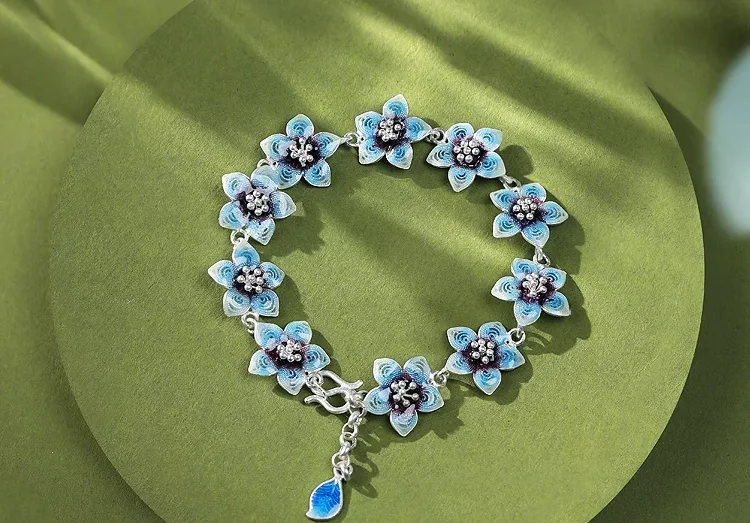
Cloisonné is one of those techniques that seems almost too delicate to survive modern speed. Fine metal lines are shaped by hand, compartments are filled with enamel, and colour is fixed through repeated firing until the surface becomes both luminous and durable. What looks ornamental from a distance is, in fact, a very disciplined conversation between metal, glass, and heat.
Its beauty does not come from colour alone. It comes from containment: colour held by line, brightness held by structure, softness held by labour. That tension is what gives cloisonné its peculiar depth, especially when the work is carried on silver rather than a more anonymous base.
Before enamel can be admired, the pattern has to exist as a map. In cloisonné, this begins with wire. Thin metal strips are bent, placed, and fixed to create tiny cells that will later hold colour. Those lines are not decoration added afterward. They are the architecture of the whole piece.
That is why good cloisonné feels so composed. Even when the palette is rich, the line keeps the work from dissolving into softness. Form remains clear. Each petal, leaf, or cloud motif is given a boundary and, with it, a rhythm.
The demanding part is scale. A bracelet, pendant, or hair ornament offers very little room for error. The wire must be shaped with enough accuracy to hold the design, but not so mechanically that the pattern loses grace. Tiny deviations can disturb symmetry, crowd colour, or flatten the movement of the motif.
This is where craftsmanship becomes visible to the patient eye. Good wirework has a steadiness that feels almost calm. It neither trembles nor tries too hard to impress. The pattern reads clearly before the enamel has even been added.

Once the cells are prepared, enamel is added in stages rather than all at once. The piece is fired, cooled, inspected, and often filled again. Surfaces may be sanded back and re-fired so that colour and metal reach the right level together. This cycle of return is essential. Cloisonné is not made in one gesture; it is corrected into refinement.
Because enamel behaves differently under heat depending on thickness, pigment, and kiln conditions, the maker works with both intention and response. The hand must plan, but it must also read what the fire has done.
In cloisonné, colour is never simply applied. It is built, fired, levelled, and brought back into order.
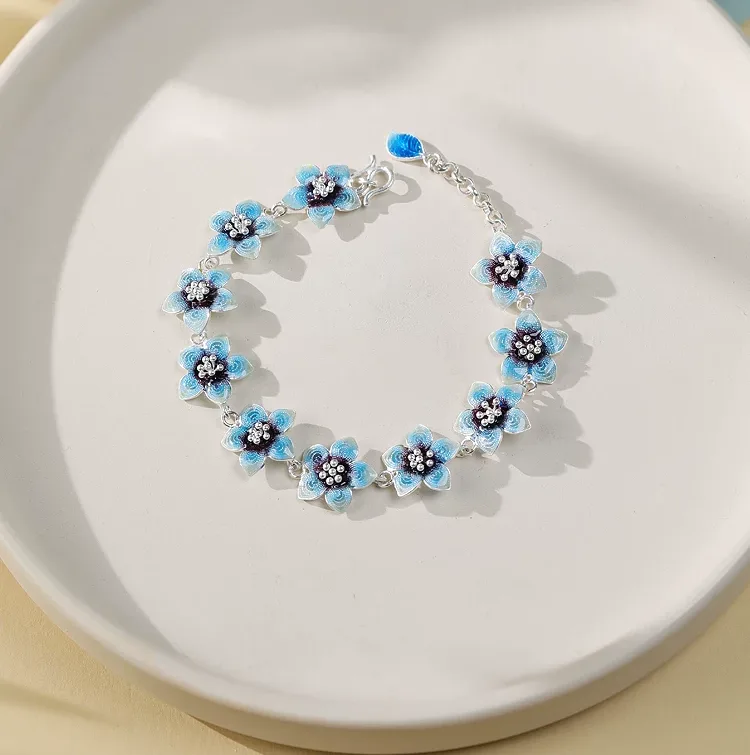
When cloisonné is carried on sterling silver, the result changes subtly but meaningfully. Silver brings a clearer light beneath the colour and a quieter sense of value beneath the surface. It asks for better finishing because the metal itself is worth reading, not merely covering.
This also makes the object feel less like costume and more like heirloom work. The materials are speaking on the same level: silver for structure and longevity, enamel for colour and atmosphere, handwork for the precision that binds them together.
Part of cloisonné’s enduring appeal is that it never looks entirely flat. Light catches on the metal lines, sinks into the enamel, and returns differently as the piece moves. The surface remains active. It rewards closeness.
That is why the technique still matters now. It preserves an older belief that decoration can also be discipline, and that beauty becomes more convincing when structure and patience are visible inside it. A well-made cloisonné piece does not only show colour. It shows the labour that gave colour its shape.