
Subscribe to stay in-the-know
Enter your details to receive communications about our products and services, events, and cultural endeavours.
Subscribe to stay in-the-know
Enter your details to receive communications about our products and services, events, and cultural endeavours.
And why your body already knows the difference.
There is a particular kind of afternoon that many people recognise — one where a stick of incense is lit with the intention of calm, and yet something feels quietly wrong. A tightness in the throat. A headache that arrives uninvited. The smoke curls upward as expected, but the body offers its own response.
This dissonance is more common than it should be. And understanding why requires looking more closely at what most incense is actually made of.
Most commercially available incense — including many products sold as “handmade” or “artisan” — is made by dipping a plain, unscented stick into synthetic fragrance oil. The oil is laboratory-formulated to smell pleasant. It does its job efficiently. But efficiency and wellness are not always the same thing.
Synthetic fragrance compounds, when burned, can release volatile organic compounds, benzene derivatives, and fine particulate matter. The headache is not imagined. It is a response.
Natural botanical incense behaves differently. Made from resins, dried plant matter, or sticks bound with essential oils derived from actual plants, it burns in a more complex, slower way. And for many people, the physical response is different too.
The word handmade has quietly stretched to accommodate a wide range of practices. Within the incense industry, it is not uncommon for a product to be described as handmade simply because a person — rather than a machine — dipped the blank stick into fragrance oil. The hand is present. The craft, in any meaningful sense, is not.
A truly handcrafted incense involves the formulation of the base material itself: the grinding of botanicals, the blending of resins, the shaping of the stick from raw ingredients. It is a slower, more considered process.
The distinction matters not because one approach is morally superior, but because what you breathe in a closed room over the course of an hour is not a trivial consideration.
There is no universal certification for natural incense. Independent observation tends to be more reliable than brand claims.
Read the ingredients carefully. A product listing “fragrance” without further detail is, in most cases, using synthetic oil. Natural incense names its components: sandalwood, frankincense resin, dried herbs. Vagueness here is informative.
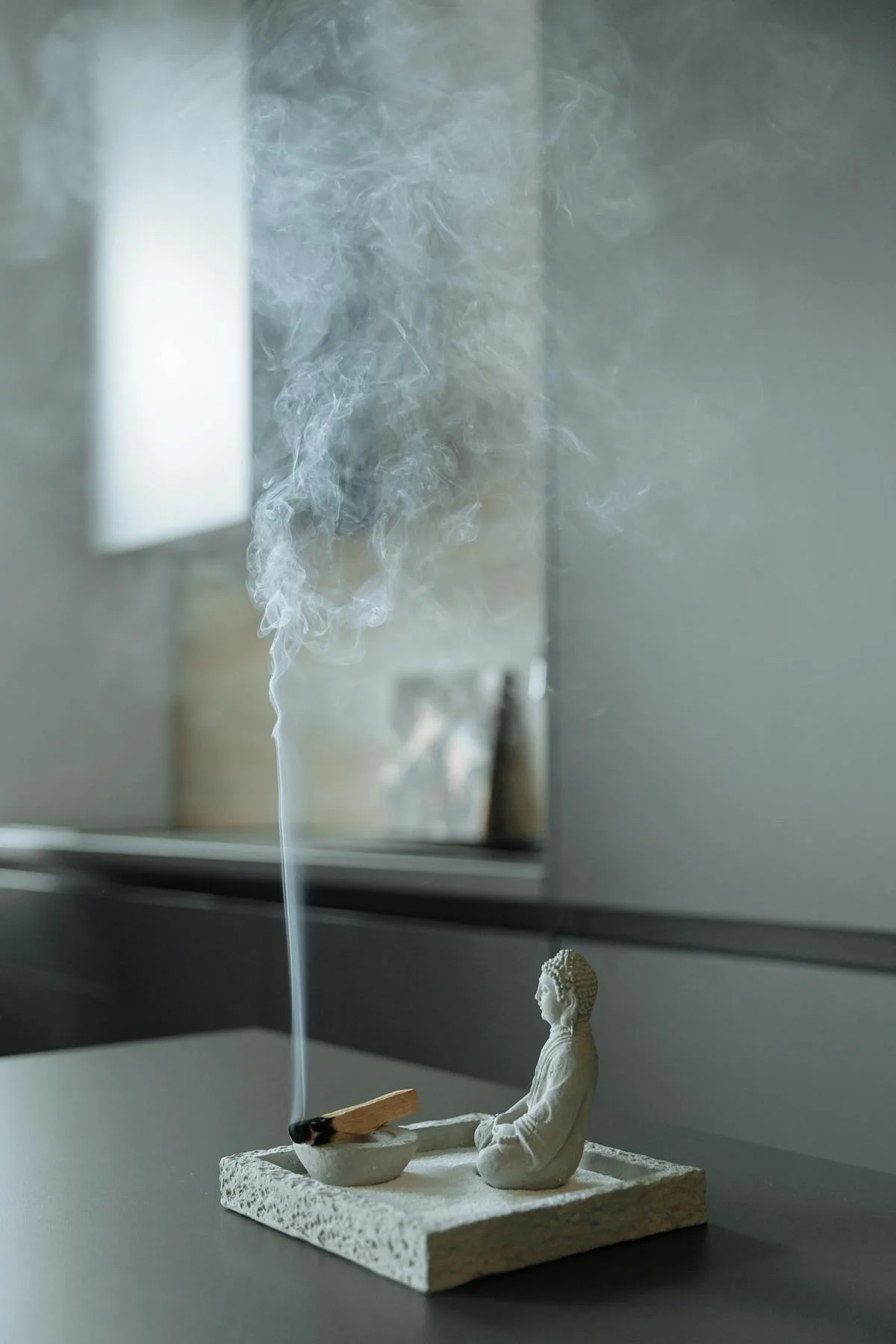
Observe the smoke. Synthetic incense produces thick, consistent smoke. Natural botanical incense produces lighter, slightly irregular smoke — its scent shifts as different components combust at different temperatures.
Ask about sourcing. A producer working with genuine botanical ingredients tends to know — and be willing to share — the provenance of their materials. Opacity about sourcing, in a product where sourcing is the entire point, is worth noting.
The objects we bring into the intimate spaces of our homes are not neutral. They carry the decisions made at every stage of their making.
Incense, perhaps more than most objects, is something you take into your body. The air in the room changes. You change it, deliberately, with the choice of what you burn.
That seems like a choice worth making carefully — not out of anxiety, but out of the same quiet attention you might bring to anything else you allow into a space you care about.