
Subscribe to stay in-the-know
Enter your details to receive communications about our products and services, events, and cultural endeavours.
Subscribe to stay in-the-know
Enter your details to receive communications about our products and services, events, and cultural endeavours.
A quiet craft shaped by material judgment, fine cutting, and the discipline of touch.

A hand-carved comb can look deceptively simple. Its scale is modest, its purpose familiar, and its form easily taken for granted. Yet this kind of object reveals craftsmanship in one of its most intimate forms. It has to sit comfortably in the hand, move cleanly through the hair, and withstand repeated use without feeling harsh or careless.
That makes the comb a useful reminder that craft is not reserved for spectacle. Some of the most demanding work happens in objects whose success depends on touch, proportion, and restraint rather than on display. A comb has very little room to hide bad decisions.
Wood selection matters from the beginning. The blank must have enough density and stability to hold a narrow series of teeth without becoming fragile. Grain direction affects both strength and appearance. Even before carving begins, the maker is already judging what kind of pressure the material can take and what kind of finish it might later accept.
This is especially important with darker, denser woods such as ebony and with aromatic woods valued for both tactility and visual quiet. The finished comb may feel serene, but the serenity begins with disciplined material choice.
Once the blank is chosen, the outline of the comb has to be shaped with enough sensitivity to balance strength and elegance. Too much thickness, and the comb feels clumsy. Too little, and it loses confidence in the hand. Curves must support grip without turning ornamental for its own sake.
A good hand-carved comb often looks inevitable, as though it could not have taken another form. That sense of inevitability is the result of editing — removing enough material to refine the object, but not so much that the comb loses its working integrity.
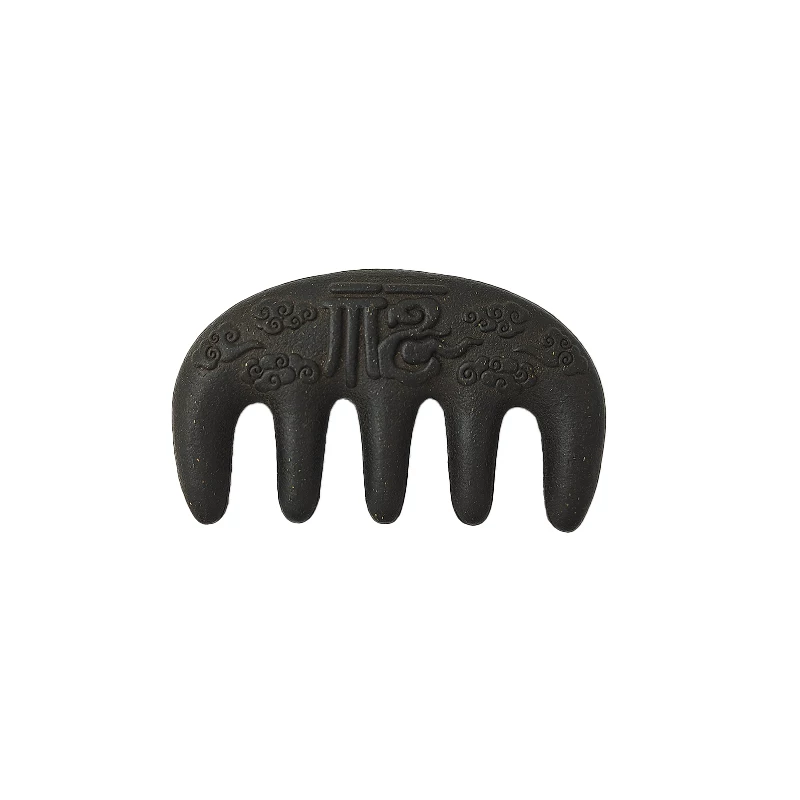
The teeth are where skill becomes uncompromising. They must be evenly spaced, strong enough to endure pressure, and refined enough not to scratch. This is one of the reasons machine-like perfection is not the only measure of quality. What matters is whether the maker has given each tooth enough attention to feel smooth, consistent, and trustworthy in use.
In practice, this means careful cutting followed by repeated refinement. Tiny irregularities that might be invisible from afar become obvious the moment the comb is used. The hand notices what the eye may miss.
Small tools are exacting because they are judged by the body first. A comb is either gentle in use, or it is not.
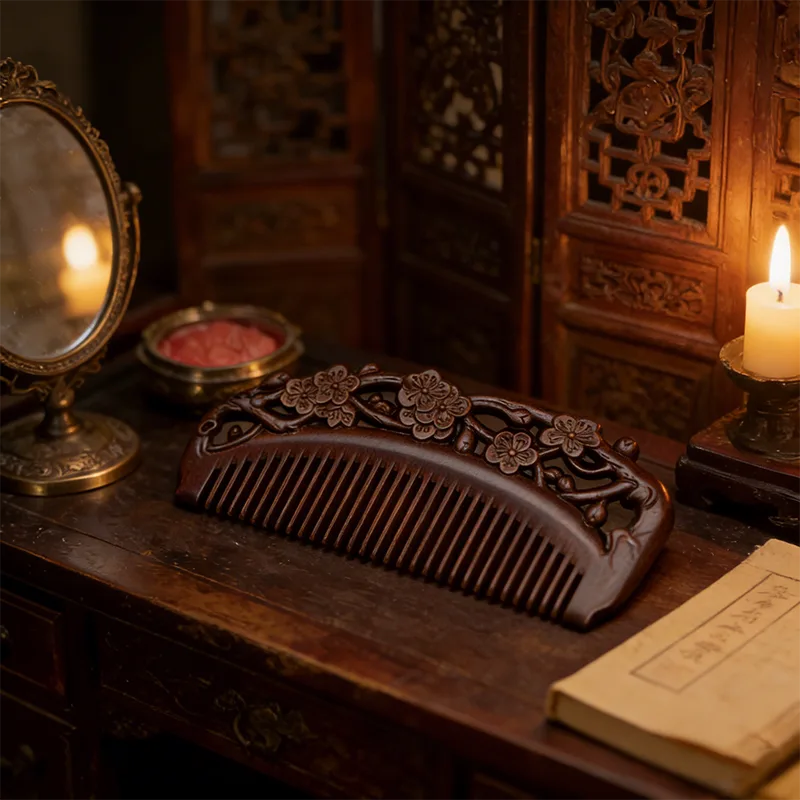
After shaping comes the slower work of finishing. Sanding softens edges, refines transitions, and prepares the surface to be touched repeatedly without irritation. A good finish should protect the comb while allowing the wood to remain visually legible. Too much coating and the object begins to feel sealed off from itself; too little and it may feel unfinished.
This final stage is where the comb becomes more than a carved shape. It becomes a tactile instrument.
We often reserve the language of craftsmanship for furniture, ceramics, metalwork, or textiles, but grooming tools deserve the same seriousness when they are well made. A hand-carved comb enters life at a close distance. It is handled without ceremony, yet it accumulates familiarity quickly.
That is why it remains worth making carefully. In a culture of disposable grooming accessories, a comb shaped with attention offers another model: useful, durable, calm, and made to stay. Its value lies not in scale, but in repetition. The object proves itself every time it is picked up.