Subscribe to stay in-the-know
Enter your details to receive communications about our products and services, events, and cultural endeavours.
Subscribe to stay in-the-know
Enter your details to receive communications about our products and services, events, and cultural endeavours.
On reading metal honestly, and choosing pieces that age with intention.
Something changes in the way a person looks at jewellery once they have experienced the quiet disappointment of watching a piece they loved turn dark. The silver that looked so clean in the shop, or in the photograph, develops a shadow — at first subtle, then unmistakable. And with it comes a question that is harder to answer than it should be: was this supposed to happen?
The answer is: it depends. And understanding what it depends on is, in most cases, more useful than any cleaning tip.
Sterling silver tarnishes. This is not a defect. It is a property of the metal — a natural oxidation that occurs when silver reacts with sulphur compounds in the air, in water, in skin. A piece that never tarnishes is almost certainly not sterling silver.
People are often sold the idea that quality means permanence — that a piece which holds its shine is somehow better made. But tarnish is a sign of authenticity. What matters is not whether it tarnishes, but how.

A well-made piece develops a patina — a gradual, even darkening that softens its brightness and gives it depth. This is different from the uneven, blotchy discolouration of poor alloy composition or a thin plating over base metal. The difference is legible, if you know what to look for.
Sterling silver is 92.5% pure silver — hence the hallmark 925 — alloyed with 7.5% of another metal, most commonly copper. The copper is what gives sterling its durability; pure silver is too soft to hold a shape. It is also what makes it prone to tarnish, since copper oxidises readily.
The 925 mark, when genuine, tells you something specific about the metal’s composition. The difficulty is that the mark can be replicated. What cannot easily be faked is the behaviour of the metal over time — or the weight of it in the hand.
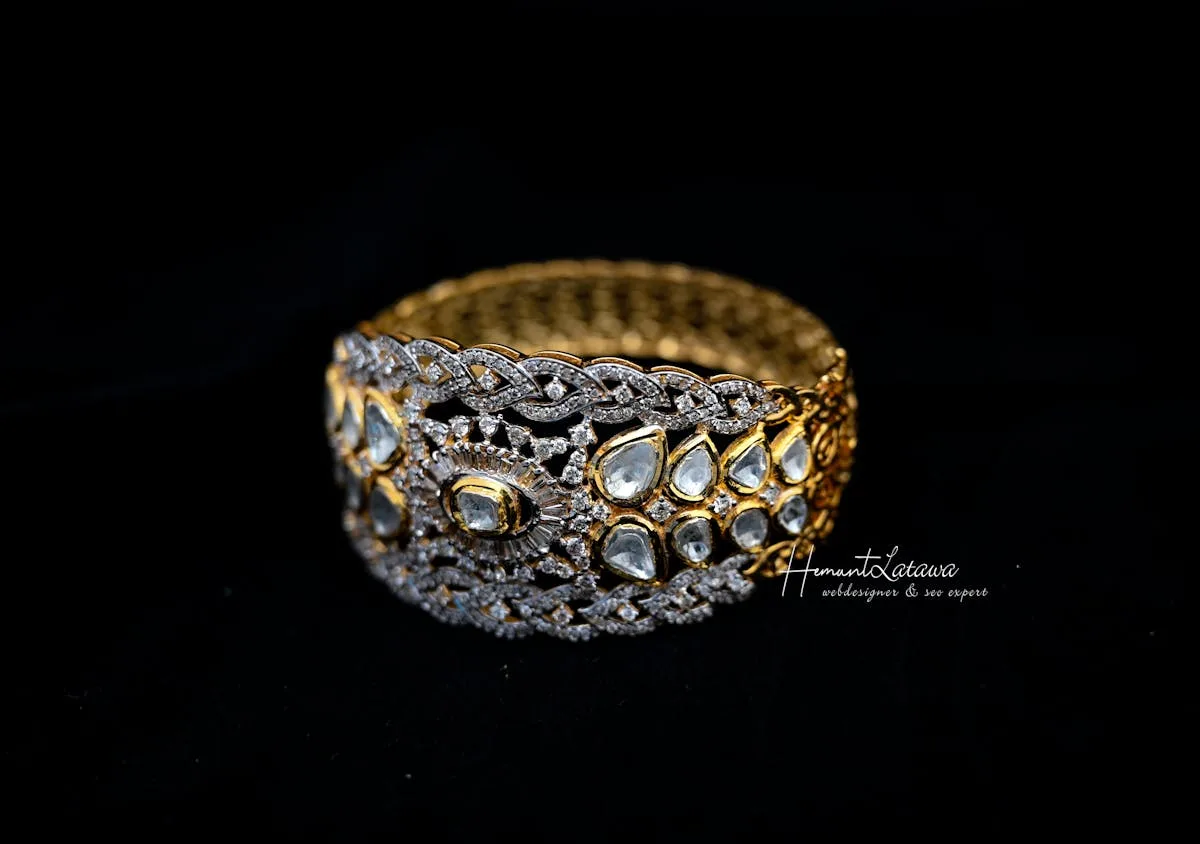
Sterling has a particular density — around 10.36 g/cm³ — that gives it a satisfying solidity. Plated pieces, built over brass or zinc alloy, are lighter in a way that becomes perceptible once you have held enough genuine silver. This is a starting point for developing a sense of what real metal feels like.
Green discolouration on the skin is not caused by tarnishing silver. It is caused by copper — specifically, the reaction between copper in the alloy and the acids and moisture on the skin’s surface, producing copper chloride compounds that transfer as a greenish residue.
This can happen with genuine sterling, particularly for people with more acidic skin chemistry, in hot climates, or during exercise. It is not, by itself, evidence of fraudulent metal. However, when green staining appears very quickly and is accompanied by obvious discolouration of the metal itself, it more likely indicates a high proportion of copper or zinc beneath a thin silver coating.
Genuine sterling, worn consistently, tends to build a stable relationship with its wearer’s skin over time — the oils of regular contact actually help slow the tarnishing process. A piece that worsens with wear, rather than settling, warrants closer attention.
There is no single test that confirms quality at a glance. But a few things, considered together, give a more complete picture.
Look for visible craft marks. Handmade silver bears the traces of its making — small irregularities, tool marks, surfaces that catch light differently from different angles. These are not imperfections. They are evidence. A piece that is perfectly uniform in every detail has almost certainly been cast or stamped at scale.
Ask what alloy is used. Some silversmiths use argentium silver — a silver-germanium alloy notably more resistant to tarnish and hypoallergenic. A maker who can tell you exactly what they work with, and why, is a maker who understands their material.
Consider the finish in relation to the price. Rhodium plating — a thin coating of platinum-group metal applied over sterling to prevent tarnish — is common in high-street jewellery. When it wears through, the underlying silver will tarnish rapidly at those points. Knowing whether a finish is rhodium-plated or uncoated sterling helps set accurate expectations for care.
There is a particular kind of object that only becomes more itself with use. Sterling silver, at its best, is one of these. A ring worn daily for a decade develops a surface quality — a warmth, a smoothness in the high points — that no new piece can replicate. The patina is not a failure of the metal. It is a record of contact.
This is what separates a piece worth caring for from one that is simply bought and eventually discarded. The question, when choosing silver, is not only whether it is well-made now — but whether it is the kind of thing that will be worth maintaining.
The metal that changes with you is not failing. It is simply keeping an honest record of where it has been.